



Imagine walking into a room expecting nothing more than four walls, a few lights, and perhaps a screen. Then something changes. The lighting responds to your movement. A sound seems to follow you. Images appear across surfaces. The architecture suddenly feels alive, and instead of standing outside the experience, you realize you are inside it.
That is the idea increasingly associated with spaietacle.
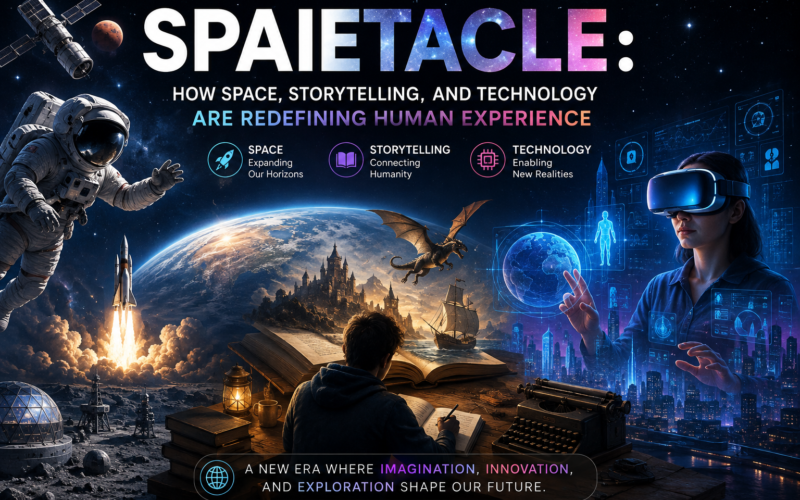
The word is still emerging, and its definition is not fixed in major dictionaries. Yet across recent discussions, a consistent idea is beginning to appear: spaietacle describes an experience where space becomes part of the story rather than simply serving as its background. It sits at the intersection of spatial design, spectacle, technology, storytelling, and human participation.
For technology leaders, designers, entrepreneurs, and creators, that distinction matters. The next generation of digital experiences may not be defined simply by faster interfaces or better screens. Instead, they may be defined by how effectively technology changes the way people experience an environment.
What Does Spaietacle Actually Mean?
At its simplest, spaietacle can be understood as a blend of space and spectacle. A traditional spectacle is something people watch. A concert, theater performance, film, fireworks display, or presentation generally places the audience on one side and the performance on the other.
Spaietacle changes that relationship. Here, the environment becomes part of the experience. The audience may move through the space, interact with digital elements, influence what happens next, or experience a story through multiple senses. Recent explanations of the term consistently emphasize this shift from passive observation toward participation.
That does not mean every immersive installation qualifies. Technology alone is not enough. A room covered in expensive projections can still feel empty if there is no coherent story or meaningful interaction. The stronger interpretation is more deliberate: space, sensory design, narrative, and participation work together toward a specific emotional or intellectual outcome.
Why the Concept Is Appearing Now
The idea behind spaietacle is not entirely new. Humans have always used architecture, light, sound, ritual, theater, and public spaces to create emotional experiences. What has changed is the technology available to designers.
Projection mapping can transform buildings into dynamic canvases. Sensors can detect movement. Spatial audio can create directional sound. Augmented reality can add digital layers to physical environments. Artificial intelligence can potentially personalize experiences according to individual behavior.
As these technologies become more accessible, the boundary between physical and digital environments becomes increasingly flexible. That creates an important opportunity. For decades, digital products largely existed inside screens. Websites lived inside browsers. Apps lived inside phones. Games lived inside displays. Spaietacle represents a broader way of thinking: technology can become part of the surrounding environment rather than remaining confined to a rectangle.
From Audience to Participant
Perhaps the most important idea behind spaietacle is participation. Consider the difference between watching an interactive story and physically moving through one. In the first scenario, the viewer receives information. In the second, movement itself can become part of the narrative. The participant decides where to look, what to explore, and sometimes what happens next.
This distinction has implications far beyond entertainment. Museums can use immersive environments to make historical subjects more tangible. Educational institutions can create learning environments where students explore concepts instead of merely reading about them. Retailers can turn stores into experiential spaces. Hospitality businesses can use sensory design to make physical locations more memorable.
In each case, the objective is not simply to impress people. It is to make them feel involved.
The Technology Behind the Experience
Technology is an important enabler, but it should remain subordinate to the experience.
| Technology | Potential role in a spaietacle experience |
|---|---|
| Projection mapping | Turns walls, floors, and buildings into dynamic visual environments |
| Spatial audio | Creates directional and location-based sound |
| Sensors | Allows environments to respond to movement or behavior |
| Augmented reality | Adds digital information to physical surroundings |
| Virtual reality | Creates fully simulated environments |
| Artificial intelligence | Enables adaptive or personalized experiences |
| Interactive displays | Gives participants direct control over content |
The interesting point is that none of these technologies automatically creates a meaningful experience. A sensor is simply a sensor. A projector is simply a projector. AI is simply a tool. The value emerges when those technologies are combined with a clear understanding of people. That is where experience design becomes more important than technical novelty.
Why Storytelling Still Matters
It is tempting to think that immersive technology can carry an experience by itself. History suggests otherwise. People remember stories. A visually impressive installation may capture attention for a few minutes. A well-designed narrative can stay with someone for years.
This is why storytelling should sit at the center of any serious interpretation of spaietacle. The environment needs a reason to exist. Every visual element, sound, transition, and interaction should contribute to an underlying idea. Imagine a museum exhibition about climate change.
One approach might present visitors with charts and paragraphs. Another might place them inside an evolving environment where temperature, sound, imagery, and physical space change as they move through different stages of the story. The second approach does not eliminate information. It gives information context. That difference can transform learning from an intellectual exercise into an emotional experience.
Spaietacle and the Experience Economy
Businesses have spent years moving from selling products toward selling experiences. Coffee shops compete on atmosphere. Retailers create showrooms rather than simple stores. Hotels invest in distinctive environments. Technology companies obsess over user experience.
Spaietacle fits naturally into this movement. Consumers increasingly encounter endless digital content every day. A photograph can be scrolled past in seconds. A video can be skipped. An advertisement can disappear with a swipe. Physical and interactive experiences operate differently.
When people enter an environment and become part of it, their relationship with the content changes. They are no longer simply consuming information. They are generating memories. For brands, that can be powerful.
However, there is an important warning. Experience should not become an excuse for unnecessary spectacle. If a brand creates an immersive environment that looks impressive but communicates nothing meaningful, visitors may remember the technology while forgetting the company. The strongest experiences connect emotion with purpose.
Applications Beyond Entertainment
Although immersive entertainment is an obvious application, the broader possibilities are more interesting. In education, environments can help students visualize complex scientific, historical, or geographic concepts. In healthcare, carefully designed spaces could potentially reduce anxiety, improve orientation, or create more supportive environments for patients and visitors.
A website does not literally need walls and projections to adopt the philosophy. It can use movement, sound, narrative structure, personalization, and interactive journeys to create a stronger sense of place. This flexibility may be one of the concept’s greatest strengths.
The Difference Between Immersion and Gimmick
There is a danger attached to every emerging technology trend: confusing novelty with value. Immersion can become a gimmick. A room does not become meaningful simply because every surface contains animation. An app does not become innovative because it includes unnecessary 3D effects. A marketing campaign does not become memorable merely because it uses augmented reality. Good design begins with a question:
What should the person feel, understand, discover, or remember?
Only after answering that question should creators decide which technologies belong in the experience. This principle is especially important for startups. Entrepreneurs often become excited about what technology can do before identifying what users actually need.
Spaietacle works best when the order is reversed. Start with the human outcome. Design the experience around it. Then select technology that supports the idea.
The Business Opportunity
For founders and technology companies, this emerging concept points toward a larger market opportunity. The future of digital interaction may increasingly involve environments rather than interfaces alone. These possibilities create new categories of products and services.
They also create demand for multidisciplinary teams. A successful project may require software engineers, architects, visual artists, sound designers, UX researchers, storytellers, behavioral scientists, and business strategists.
That collaboration is significant because immersive experiences rarely belong to one traditional industry. They sit between them.
Designing for Humans, Not Technology
The most important lesson behind spaietacle may ultimately have little to do with technology. It is about attention. People do not experience environments as collections of technical specifications. They sense whether an interaction feels natural or forced. They remember moments that surprised them, moved them, or gave them a feeling of discovery. Therefore, designers need to think beyond functionality.
What does the person see first?
Where does their attention go?
What happens when they move?
What choices can they make?
Emotional transition occurs from beginning to end?
These questions can matter more than the number of sensors, displays, or AI systems installed.
The Future of Spaietacle
The future of spaietacle will likely be shaped by the convergence of physical and digital worlds. Artificial intelligence could make environments more adaptive. Spatial computing could make digital information feel increasingly anchored to physical surroundings. Advances in sensors may allow spaces to respond more naturally to people.
Yet the technology will continue evolving.
The underlying human desire will remain surprisingly stable.
People want experiences that mean something.
That is why the idea has relevance beyond its unusual name.
A New Way to Think About Space
Spaietacle is still an emerging term, and its meaning will probably continue changing. Some people may use it primarily for immersive art. Others may connect it with digital experiences, brand environments, architecture, or interactive entertainment. Current explanations already show that the concept is being interpreted in several related ways.
But beneath those variations is a compelling principle: space can communicate.
Room can tell a story.
Building can create emotion.
Digital environment can feel like a place.
And technology can help make all three more responsive.
For entrepreneurs and technology leaders, this suggests a broader opportunity. The next meaningful innovation may not always be another app, platform, or device. It may be an experience that changes how people move through the world.
That is ultimately what makes spaietacle worth watching. It is not simply about making environments more spectacular. It is about making them more meaningful. As technology becomes increasingly invisible, the best innovations may be the ones people do not notice as technology at all. They simply experience something memorable, intuitive, and human and that may be the real spectacle.
Conclusion
Spaietacle represents more than an unusual emerging term. It points toward a broader shift in how people may experience technology, architecture, entertainment, and digital storytelling. Instead of keeping technology behind screens, it brings digital intelligence and interaction into the spaces people physically occupy.