



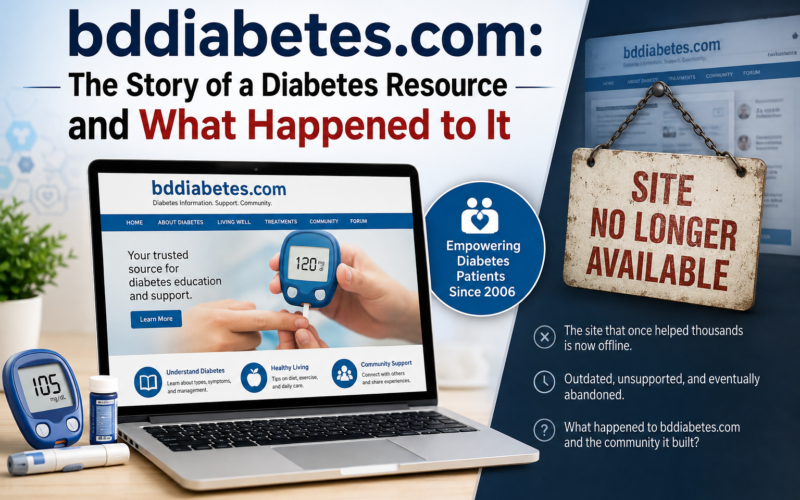
There was a time when finding reliable diabetes information online was far less straightforward than it is today. Before mobile health apps, continuous glucose monitors, and personalized digital-care platforms became common, patients often relied on printed guides and a handful of specialized websites. bddiabetes.com was part of that earlier digital-health landscape, created by Becton, Dickinson and Company (BD) as an educational destination for people living with diabetes.
The website represented an important idea for its era: diabetes care should not stop when a patient leaves the doctor’s office. People needed practical explanations about insulin delivery, blood glucose monitoring, injection techniques, and diabetes products that they could revisit at home. Historical BD materials describe BDdiabetes.com as an online educational resource, while archived references show that the platform included demonstrations and patient-focused information.
Today, however, searching for the domain can create confusion. The website belongs to an older chapter of diabetes technology and education, while BD’s diabetes-care business has since changed. Understanding that history helps explain why the name still appears in older documents, product references, and online searches.
What Was bddiabetes.com?
At its core, bddiabetes.com was a health-information website associated with BD’s diabetes-care business. Its purpose went beyond simply displaying medical products. The platform was designed to provide educational material that could help people understand aspects of insulin therapy and blood glucose management.
That distinction matters.
Diabetes is a condition in which everyday decisions become part of long-term health management. Someone starting insulin may need to understand syringes, injection technique, needle selection, glucose testing, and safe handling of supplies. A website that explains those concepts in accessible language can become an extension of the clinical conversation.
Historical records show that BD positioned its online diabetes resource alongside its broader educational initiatives, including its Getting Started materials for people beginning insulin therapy.
In other words, bddiabetes.com was not simply another corporate website. It reflected an early attempt to use the internet as a practical education tool for diabetes care.
Why the Website Mattered
The importance of bddiabetes.com becomes clearer when viewed through the technology available at the time. Modern diabetes patients can find video demonstrations, smartphone applications, online communities, continuous glucose monitoring dashboards, telehealth services, and searchable medical libraries within seconds. Earlier patients had considerably fewer digital options.
BD recognized that education could make diabetes equipment less intimidating. Historical material associated with the company describes the website as a convenient educational resource and highlights demonstrations explaining activities such as drawing, mixing, and injecting insulin. That approach was significant because technical instructions are often easier to understand when they are demonstrated rather than merely described.
A patient reading about an injection technique might still feel uncertain. A visual demonstration, however, can make the process more concrete. This principle remains relevant today. Digital health technology has changed dramatically, but the need for understandable patient education has not disappeared.
From Blood Glucose Monitoring to Injection Education
BD’s diabetes activities extended beyond syringes and needles. Historical company material describes products such as the BD Logic Blood Glucose Monitor and the BD Latitude Diabetes Management System, introduced as part of BD’s expansion into blood glucose monitoring. The significance of these products was not just technological. They represented an emerging effort to connect measurement, education, and treatment in a more integrated way.
The BD Latitude system, for example, was presented as an integrated diabetes-management approach involving monitoring and tools for testing and injection. Seen from today’s perspective, some of those ideas may seem familiar. Connected diabetes management, however, was far less mature at the beginning of the 2000s.
The broader lesson is that healthcare technology rarely arrives fully formed. Today’s digital health ecosystem has roots in earlier experiments with making medical information, monitoring, and treatment tools easier for patients to understand and use.
The Educational Side of bddiabetes.com
One of the strongest aspects of the old platform was its educational orientation. Diabetes education often has to bridge a difficult gap. Clinicians understand the medical terminology and procedures, while patients must translate that information into everyday behavior. A useful educational resource needs to respect both accuracy and accessibility.
The historical website appears to have been built around that principle. It provided product-related information and educational material designed for people managing diabetes. Archived references also show that the site included interactive demonstrations and patient education resources. That makes bddiabetes.com interesting not only as a historical website but also as an example of an early digital-health communication strategy.
What the Old Platform Could Teach
The site’s underlying philosophy remains surprisingly relevant. Good healthcare technology should answer practical questions. How does a device work? How should a person use it? What does a measurement mean? When should someone ask a healthcare professional for help?
Those questions have not changed much. What has changed is the delivery mechanism. Instead of a specialized website with animated demonstrations, today’s patients may use apps, online video libraries, connected devices, and interactive patient portals. The interface is different, but the objective is similar: make complex health information easier to understand and act upon.
What Happened to BD’s Diabetes Business?
The biggest reason people may encounter confusing information about bddiabetes.com today is the transformation of BD’s diabetes-care business. In 2022, BD separated its Diabetes Care business into a new independent company, embecta. That corporate transition changed where many diabetes-related products and resources belong.
As a result, an old BD diabetes reference should not automatically be interpreted as a current BD product or service. This is particularly important when someone discovers the domain through an old PDF, archived document, product listing, or healthcare resource directory. Historical references can remain online for years after a business changes ownership or structure.
For researchers, that creates an interesting digital-history problem. For patients, it creates a practical one: old information is not necessarily current information.
Why Old Medical Websites Require Extra Caution
A website can look authoritative while still containing information that is no longer appropriate for today’s products or clinical practices. This is one of the most important things to understand about bddiabetes.com.
Historical content may help explain how BD once presented diabetes products and education. It should not automatically be treated as current medical guidance. Consider the difference between historical product documentation and modern treatment advice. A description of an older syringe, glucose meter, needle, or injection demonstration may be accurate for that particular product and period. But that does not mean it applies to every product available today.
The safest approach is to separate historical information from current healthcare guidance.
| Information type | How to view it today |
|---|---|
| Old BD product information | Useful for historical context |
| Archived injection demonstrations | Educational background, but verify current instructions |
| Old product specifications | May no longer reflect current products |
| Historical company information | Useful for understanding BD’s diabetes business |
| Current treatment decisions | Should rely on qualified healthcare professionals and current sources |
That distinction is especially important with insulin and injection equipment. Patients should not change insulin doses, needle sizes, injection routines, or other aspects of treatment simply because they discover an old webpage.
Why bddiabetes.com Still Appears in Search Results
The internet has a long memory. A domain may stop being a primary destination while its name continues to appear in documents, databases, PDFs, product descriptions, academic references, and archived pages. That appears to be part of the story with bddiabetes.com. Historical healthcare materials still reference the domain, including diabetes education resources published years ago.
Search engines can also preserve associations long after websites change. This creates an unusual situation in which someone searching for the domain today may encounter several different versions of its history: old BD material, archived references, third-party explanations, and modern pages discussing what happened to the site. Therefore, the appearance of bddiabetes.com in a search result does not necessarily mean that the website remains an active source of current diabetes care information.
The Larger Story: From Websites to Connected Healthcare
Perhaps the most interesting way to understand bddiabetes.com is to place it within the larger evolution of digital healthcare. In the early internet era, the central question was relatively simple: Can patients find useful medical information online?
Today, the question is much more sophisticated. Can devices collect glucose data continuously? Can patients share readings with clinicians? Can algorithms identify patterns? Can digital tools help people make decisions while maintaining appropriate clinical oversight?
The healthcare industry has moved from static webpages toward connected ecosystems. Yet the older model still matters. Digital transformation does not eliminate the need for clear communication. In fact, as healthcare technology becomes more complicated, understandable education becomes even more important.
A sophisticated device is only useful if the person using it understands what it does and knows when professional guidance is necessary. That is one reason the history of bddiabetes.com remains worth examining.
What Entrepreneurs and Tech Readers Can Learn
For technology founders and healthcare entrepreneurs, the story offers a useful lesson about product design. Successful health technology is rarely about technology alone. A glucose monitor can produce measurements. A mobile application can display graphs. A connected platform can synchronize information. But none of those capabilities automatically creates better patient experiences.
The real value often comes from reducing confusion. The early educational approach behind bddiabetes.com demonstrates this principle. Product information, demonstrations, and patient resources were brought closer to the people who needed them.
Modern startups can learn from that model while improving it through personalization, accessibility, real-time data, and better user experience. The challenge is balancing convenience with responsibility. Healthcare technology cannot afford the same level of ambiguity tolerated by ordinary consumer software.
Is bddiabetes.com Still Relevant?
Yes, but primarily as a historical reference. The domain helps illustrate how diabetes companies used the early web to provide education, product information, and interactive demonstrations. Historical BD documents confirm that the site played a role in the company’s diabetes education strategy. For someone researching the development of diabetes technology, it can therefore be valuable.
For someone seeking current medical advice, however, an old website should not be the final authority. That distinction is the key to understanding its modern relevance.
Conclusion
The story of bddiabetes.com is ultimately bigger than a website address.
It represents an early stage in the transformation of healthcare from something primarily delivered through clinics and printed materials into something increasingly supported by digital technology. BD used the web to make diabetes education and product information more accessible at a time when online healthcare resources were still developing.
Today, the digital-health landscape is vastly more advanced. Yet the central challenge remains familiar: technology must help people understand their health, not simply give them more information.
For historians of technology, bddiabetes.com offers a glimpse into that transition. For patients, it serves as a reminder to distinguish archived information from current medical guidance. And for entrepreneurs, it demonstrates a timeless principle: the most useful healthcare technology is not necessarily the most complicated. It is the technology that makes an important task clearer, safer, and easier to understand.