
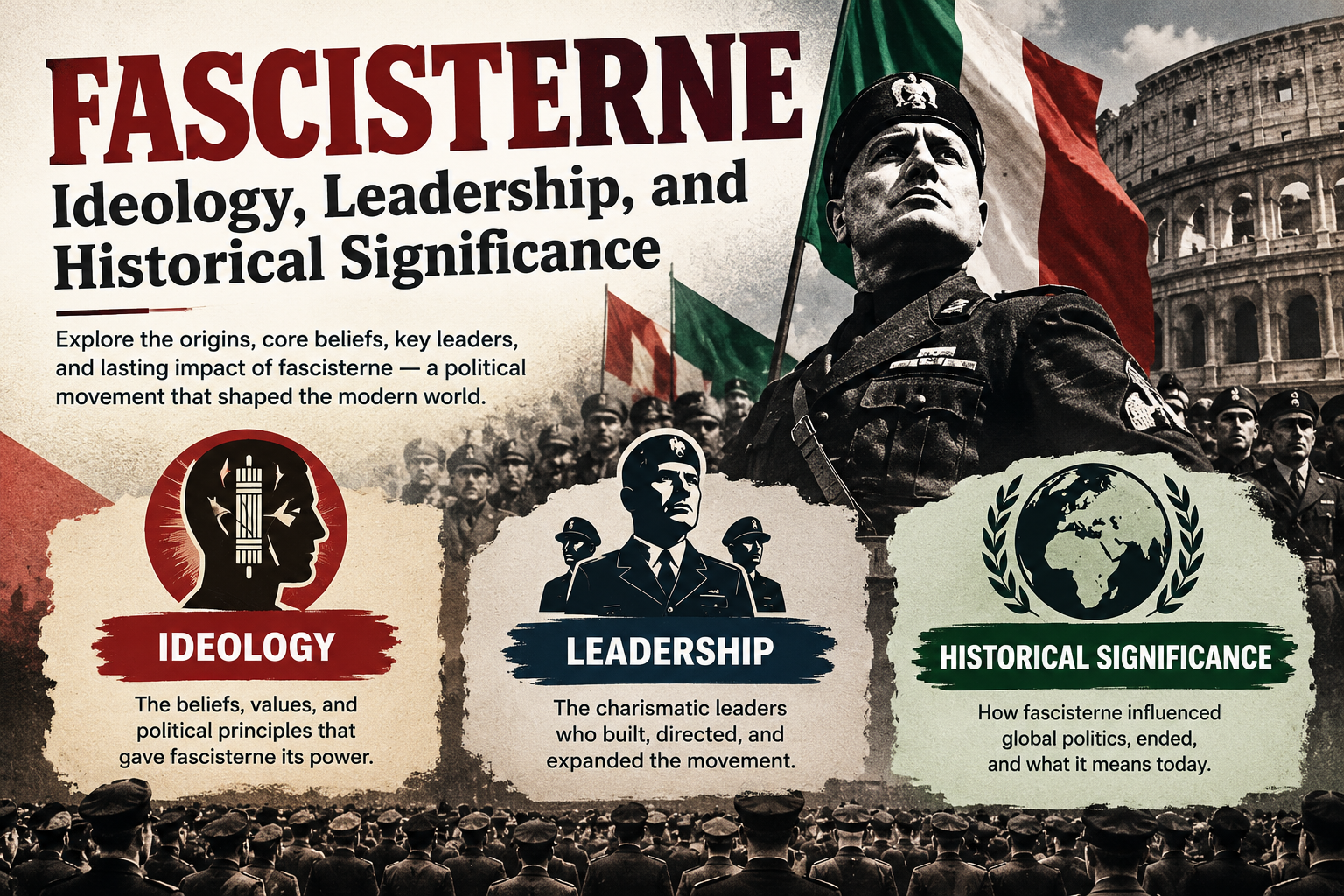
A society rarely changes overnight. Often, the transformation begins with frustration: people lose confidence in their institutions, economic uncertainty becomes part of daily life, and political leaders promise to restore stability, national pride, and a sense of belonging. In such moments, understanding fascisterne a term associated with fascists, particularly in Danish-language contexts offers an opportunity to examine how authoritarian movements emerge, gain public support, and reshape societies.
Fascism is more than a historical political label. It is an authoritarian ideology associated with extreme nationalism, loyalty to a powerful leader, hostility toward political opposition, and the subordination of individual freedoms to the interests of a supposedly unified nation. Its history, especially in twentieth-century Europe, reveals how democratic institutions can weaken when fear, propaganda, and political polarization become powerful tools.
For technology readers, entrepreneurs, and professionals, the subject also raises contemporary questions about information systems, public trust, digital communication, and the responsibility of institutions. Understanding the past does not mean assuming that every modern political conflict represents a return to fascism. Instead, it provides a framework for recognizing dangerous political patterns while evaluating present-day developments carefully.
What Does Fascisterne Mean?
The word fascisterne is Danish and generally translates to “the fascists” in English. It refers to people associated with fascism, a political ideology that developed in Europe during the early twentieth century. The related term fascist describes an adherent of that ideology or, depending on context, someone participating in a movement with distinctly fascist characteristics.
The distinction between terminology and ideology matters. Words associated with fascism sometimes appear in political arguments as insults, but their historical meaning is more specific. A careful discussion examines a movement’s beliefs, organization, methods, and attitude toward democratic institutions rather than relying on labels alone.
Fascism generally promotes an idealized national community, often portrayed as threatened by internal enemies, foreign influences, cultural change, or political weakness. Fascist movements commonly present themselves as forces of national renewal. They promise to overcome division through unity, discipline, and strong leadership.
However, this vision of unity often comes at a considerable cost. Political pluralism is treated as an obstacle, opposition becomes disloyalty, and individual rights may be sacrificed to collective objectives defined by the ruling movement. Groups identified as outsiders or enemies can face discrimination, persecution, and violence.
Fascism has taken different forms in different countries. Nevertheless, its recurring characteristics help historians distinguish it from other authoritarian systems and from ordinary nationalist or conservative politics.
The Historical Origins of Fascism
Modern fascism emerged amid the instability that followed World War I. The conflict had devastated communities, disrupted economies, transformed political borders, and left millions of people dealing with grief, disability, displacement, and uncertainty. In several European countries, existing political systems struggled to respond to the scale of these challenges.
Italy became the birthplace of the first successful fascist movement under Benito Mussolini. Founded in 1919, Mussolini’s movement exploited postwar frustration, fear of socialist revolution, nationalist resentment, and dissatisfaction with parliamentary politics. Fascist squads used intimidation and violence against political opponents, including socialists, trade unionists, and other perceived enemies.
Mussolini became prime minister in 1922 following the March on Rome. His government gradually dismantled democratic safeguards, restricted the press, suppressed opposition parties, and established a dictatorship. The Italian experience demonstrated how a movement could exploit legal political opportunities while using coercion to weaken the institutions that made its rise possible.
Germany’s Nazi movement developed within a different but related environment. The Weimar Republic faced political instability, resentment over the Treaty of Versailles, economic hardship, and the devastating effects of the Great Depression. Adolf Hitler and the Nazi Party combined extreme nationalism, antisemitism, conspiracy theories, and promises of national revival to attract supporters.
Hitler became chancellor in January 1933. The Nazi regime subsequently destroyed democratic competition, established a police state, and pursued systematic persecution. Its policies culminated in the Holocaust, the genocide of six million Jews, alongside the persecution and mass murder of millions of other victims, including Roma, disabled people, Soviet prisoners of war, and political opponents.
These histories show that fascism did not emerge from a single cause. Economic distress, political polarization, nationalism, institutional weakness, and organized violence interacted in different ways. Public support mattered, but so did elite decisions, coercive organizations, propaganda, and the failure of institutions to defend democratic rules.
Core Characteristics of Fascist Movements
Fascist movements differ in their national histories and political strategies, but scholars commonly identify several recurring features. One is extreme nationalism. The nation is portrayed as a superior or sacred community that must be restored to an imagined period of greatness. Complex historical realities are replaced with simplified stories of past glory, present humiliation, and future redemption.
Another characteristic is authoritarian leadership. A leader is presented as uniquely capable of understanding the nation’s needs and overcoming supposedly corrupt institutions. Personal loyalty can become more important than laws, evidence, professional competence, or independent judgment.
Fascism also tends to reject political pluralism. Opposition parties, independent journalists, labor organizations, courts, and civil society groups may be portrayed as enemies rather than legitimate participants in public life. In this environment, disagreement is treated not as a normal feature of democracy but as evidence of betrayal.
The identification of scapegoats is another recurring pattern. Fascist movements often blame minorities, immigrants, ideological opponents, or other targeted groups for national decline. These claims can create a sense of shared identity among supporters while encouraging discrimination and exclusion.
Finally, fascist movements have historically used propaganda, intimidation, and political violence to consolidate power. They may celebrate military strength, demand social conformity, and glorify sacrifice for the nation. These characteristics are especially dangerous when combined with institutions that can no longer hold political leaders accountable. Understanding these features requires attention to the overall pattern. A single nationalist statement, strict government policy, or controversial political position does not by itself establish that a movement is fascist.
Fascism Compared With Other Political Systems
The term becomes more useful when its meaning is distinguished from related political concepts.
| Political system or ideology | Defining characteristics | Relationship to democracy |
|---|---|---|
| Fascism | Extreme nationalism, authoritarian leadership, suppression of opposition, and a vision of national rebirth | Seeks to eliminate meaningful political pluralism |
| Authoritarianism | Concentration of power and restrictions on political freedoms | May retain some institutions without allowing genuine competition |
| Totalitarianism | Extensive state efforts to control political, social, and often private life | Rejects independent centers of power |
| Democracy | Competitive elections, political participation, legal accountability, and protected rights | Depends on meaningful competition and institutional safeguards |
| Ordinary nationalism | Emphasis on national identity, sovereignty, or cultural belonging | Can operate within democratic systems |
These categories overlap, but they are not interchangeable. Fascism is generally understood as a particular revolutionary form of authoritarian ultranationalism, while authoritarianism describes a broader range of political arrangements. Totalitarianism refers to an especially extensive ambition to control society.
National pride, patriotism, and support for strong public institutions do not automatically indicate fascism. The critical questions concern how power is exercised, whether opponents retain their rights, whether minorities receive equal protection, and whether political leaders accept genuine limits on their authority.
Propaganda, Media, and the Control of Information
Fascist movements have historically understood that political power depends partly on controlling how people interpret events. Propaganda turns complicated problems into emotionally compelling stories. It identifies heroes, invents or exaggerates enemies, repeats slogans, and presents the movement as the only legitimate defender of national interests.
In Nazi Germany, the regime brought newspapers, radio, film, education, and cultural institutions under increasing state control. Independent journalism was suppressed, dissenting ideas were restricted, and antisemitic messages were disseminated throughout public life. Information control helped the regime normalize persecution and make its political worldview appear unavoidable.
Modern communication technologies create a different environment, but the underlying questions remain relevant. Digital platforms allow information to travel rapidly across borders, while recommendation systems, coordinated accounts, manipulated images, and misleading headlines can influence public attention.
It is important, however, not to equate every misleading online post with fascist propaganda. Disinformation can originate from many political, commercial, or individual sources. The more significant concern is a sustained effort to delegitimize independent evidence, portray all critics as enemies, and encourage unquestioning loyalty to a political leader or movement.
Digital literacy therefore becomes a civic skill. Readers benefit from checking original sources, comparing credible reporting, examining the context of images and quotations, and distinguishing verifiable facts from emotionally charged interpretations.
Technology companies also have responsibilities. Transparent moderation policies, accessible reporting systems, careful handling of coordinated manipulation, and clear explanations of recommendation practices can help protect information quality. These measures should be designed with freedom of expression and fair treatment in mind rather than used to silence legitimate disagreement.
Why Fascism Gains Support During Times of Crisis
Political movements often gain momentum when people believe established institutions can no longer solve their problems. Unemployment, inflation, corruption, social conflict, and fears about national identity can create an environment in which radical promises become attractive. Fascist leaders have historically used these anxieties to present themselves as alternatives to slow or divided democratic governments. Their message is often straightforward: the country has been weakened by corrupt elites and internal enemies, and only decisive leadership can restore order.
Such narratives can be persuasive because they offer emotional certainty during periods of confusion. They provide identifiable causes for complex problems and promise immediate solutions to challenges that may require years of policy work, compromise, and institutional reform. Yet the apparent simplicity of these promises can conceal serious risks. Concentrating power in one leader does not eliminate economic complexity or social disagreement. Instead, it can prevent criticism, weaken accountability, and allow damaging policies to continue without meaningful scrutiny.
Historical experience also demonstrates that authoritarian movements rarely rely on persuasion alone. Political intimidation, alliances with influential institutions, attacks on opponents, and the gradual weakening of legal protections can all contribute to their success. The lesson is not that every period of instability produces fascism. Many societies face severe crises without abandoning democratic government. What matters is how political actors respond, whether citizens retain meaningful choices, and whether institutions remain capable of limiting abuses of power.
The Impact on Society, Business, and Innovation
Fascism’s consequences extend beyond elections and government structures. When political loyalty becomes a condition for participation in public life, the effects can spread into education, employment, commerce, scientific research, and cultural expression. For businesses, predictable laws and independent institutions provide the foundation for long-term planning. Companies need reliable contracts, fair competition, access to information, and confidence that commercial decisions will not be overridden by arbitrary political demands.
Under authoritarian systems, these protections may weaken. Business leaders can face pressure to demonstrate political loyalty, independent organizations may lose their freedom to operate, and access to markets or public contracts may depend increasingly on relationships with those in power. Innovation can suffer under similar conditions. Scientific progress depends on open inquiry, constructive disagreement, and the freedom to challenge established assumptions. When researchers, journalists, or technology professionals fear punishment for inconvenient findings, organizations lose valuable sources of feedback.
Consider a technology company developing a product that raises concerns about privacy or public safety. In a healthy institutional environment, employees can report problems, journalists can investigate, and regulators can examine the evidence. Where criticism is treated as disloyalty, those safeguards become harder to maintain.
This does not mean that every authoritarian government produces the same economic results or that technological development stops entirely under authoritarian rule. Historical circumstances vary. The broader point is that sustainable innovation requires more than investment and technical expertise; it also benefits from trust, accountability, and the ability to question powerful decision-makers.
Recognizing Warning Signs Without Misusing the Label
Historical knowledge is most useful when it encourages careful judgment rather than automatic comparisons. Fascism is a serious political category, and applying it indiscriminately can obscure meaningful differences between movements and weaken public discussion.
A more productive approach examines observable behavior. Are political opponents permitted to organize and compete? Can journalists investigate government decisions without systematic intimidation? Do courts operate independently? Are minority rights protected equally? Do leaders accept election results and legal limits on their authority?
Other warning signs include the systematic dehumanization of targeted groups, the normalization of political violence, the portrayal of independent institutions as enemies, and persistent claims that only one leader or movement represents the legitimate nation.
No single indicator necessarily establishes that a movement is fascist. Historians and political scientists consider combinations of ideology, rhetoric, organization, political objectives, and behavior over time. Evidence and context matter. Citizens can apply the same discipline when evaluating information online. Instead of accepting an alarming comparison because it confirms an existing opinion, they can examine the underlying claims, consult historical research, and seek reporting from multiple reliable sources.
This approach is especially important in polarized environments, where political labels can become shortcuts for dismissing opponents. Democratic debate requires the ability to criticize dangerous behavior firmly while remaining accurate about what that behavior represents.
What the History of Fascisterne Teaches Modern Readers
The history associated with fascisterne offers lessons for people working in technology, business, education, journalism, and public service. One of the most important is that democratic institutions depend on everyday choices as well as formal rules.
Constitutions and courts matter, but their effectiveness also depends on people who respect their independence. Journalists must be able to investigate. Businesses must make decisions responsibly. Educators must encourage critical thinking. Citizens must have access to trustworthy information and the freedom to participate in public life.
Technology adds another dimension to these responsibilities. Digital platforms can connect communities, expose wrongdoing, and broaden access to knowledge. They can also accelerate harassment, spread fabricated narratives, and make it easier for organized groups to manipulate public attention.
There is no single technological solution to these challenges. Effective responses require a combination of digital literacy, transparent institutions, responsible product design, independent journalism, and public accountability.
For business leaders, this means recognizing that ethical decisions are not separate from organizational resilience. A company that protects employee concerns, evaluates evidence honestly, and resists improper pressure is better positioned to identify risks before they become crises.
For readers, the lesson is equally practical: examine political claims carefully, resist scapegoating, and distinguish strong leadership from unchecked power. Confidence in democratic institutions should not require blind trust; it should be supported by transparency, evidence, and meaningful opportunities for correction.
Conclusion
Fascism developed under particular historical conditions, but its history remains relevant because it demonstrates how political movements can exploit uncertainty, transform national pride into exclusion, and weaken institutions that protect individual freedom. Understanding fascisterne requires more than learning a translation or memorizing the events of twentieth-century Europe. It requires examining how authoritarian movements build support, how propaganda influences public perception, and how societies respond when leaders challenge democratic limits.
The past should not be used to label every political disagreement as an existential threat. Instead, it should help people identify meaningful patterns, evaluate evidence, and recognize the importance of independent institutions. For modern businesses and technology professionals, the broader message is that innovation and prosperity depend on conditions that encourage openness, accountability, and informed debate. Societies are more resilient when people can question authority without fear and participate in shaping their collective future.
Ultimately, studying fascism is not simply an exercise in remembering history. It is an opportunity to understand the responsibilities that come with political freedom—and to recognize that preserving those freedoms requires informed citizens, ethical leadership, and institutions strong enough to hold power accountable.