
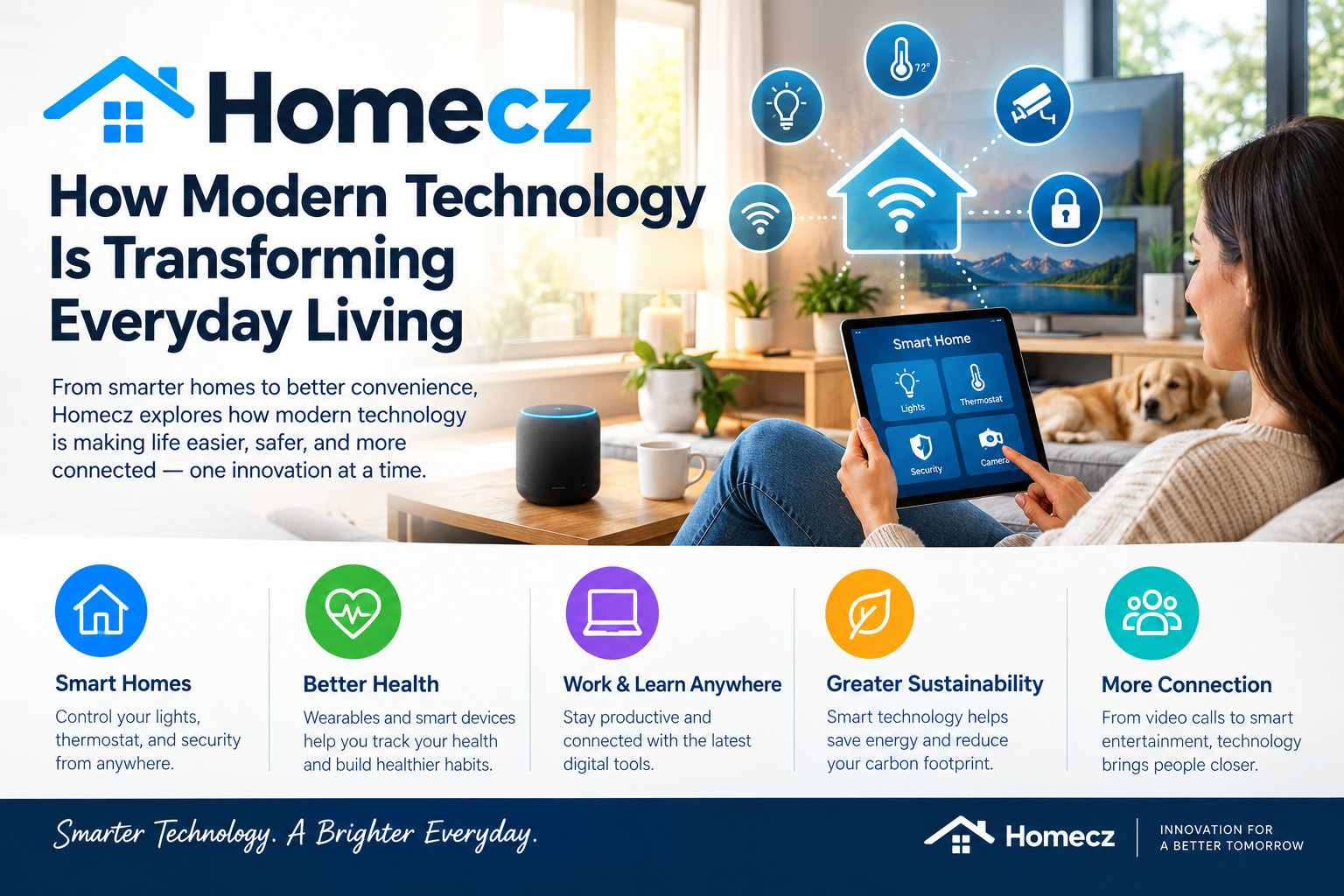
Imagine arriving home after a long day and finding the lights adjusted to your preferred brightness, the temperature set for comfort, and your security system already monitoring the entrance. Your devices communicate seamlessly, your energy consumption is easier to manage, and everyday tasks require less effort. This vision of connected living helps explain why Homecz is an interesting keyword to explore in the broader conversation about modern homes, digital innovation, and smart technology.
As technology becomes increasingly integrated into personal spaces, the meaning of a comfortable home is changing. Homeowners are no longer thinking exclusively about furniture, architecture, or location. They are also considering connectivity, automation, energy efficiency, and the digital tools that make daily routines simpler. Although the specific identity and services associated with Homecz require independent verification, the term provides an opportunity to examine how digital platforms and connected-home concepts intersect with contemporary lifestyles.
For entrepreneurs, technology professionals, and homeowners, this shift represents more than a collection of convenient gadgets. It reflects a fundamental change in how people interact with their living environments. The most valuable innovations are those that make homes more responsive without making life unnecessarily complicated.
Homecz in the Context of Digital Living
The modern home has gradually evolved from a largely physical environment into a connected ecosystem. Internet access, mobile applications, wireless sensors, and cloud-based services now influence how people manage their properties and organize everyday activities.
Within this environment, Homecz can be explored as a digital keyword associated with the broader interests surrounding residential technology, home management, and connected lifestyles. However, it would be premature to describe it as an established smart-home company, product, or service without reliable evidence confirming its identity.
This distinction matters in an online environment where unfamiliar names can quickly attract attention. A search term may represent a brand, a developing website, a niche community, or an emerging concept. Understanding which interpretation applies requires examining the available website, its ownership disclosures, published information, and actual services.
Nevertheless, the wider subject offers meaningful insights. Digital living is becoming increasingly relevant because people expect their homes to support their changing needs. Remote workers want reliable connectivity, families want practical security solutions, and environmentally conscious homeowners want better control over energy use.
The opportunity lies in understanding how technology can address these needs without turning the home into a complicated network of devices that requires constant attention.
Why Connected Homes Are Becoming More Important
A generation ago, home technology generally consisted of separate appliances and basic security equipment. Today, many residential systems can communicate through wireless networks and centralized applications.
Smart thermostats can adjust temperatures according to schedules. Connected lighting systems allow users to change brightness remotely. Video doorbells can provide notifications when someone approaches an entrance, while compatible sensors can identify certain environmental changes.
These features are not equally useful to everyone, and their benefits depend on installation quality, connectivity, cost, and personal preferences. However, they demonstrate a broader movement toward homes that respond to their occupants rather than requiring every adjustment to be made manually.
Consider a family balancing work, education, and household responsibilities. Automated lighting may offer convenience, while a programmable thermostat can help maintain a consistent indoor environment. A carefully configured security system may also provide additional visibility when residents are away.
For a technology entrepreneur, these everyday applications reveal a larger market opportunity. Successful products often emerge when developers identify small but persistent frustrations and create solutions that fit naturally into existing routines.
A concept associated with Homecz can therefore be evaluated through a practical question: does it help people manage their homes more effectively, or does it simply add another layer of technology?
The distinction between meaningful innovation and unnecessary complexity will remain important as connected devices become more common.
The Role of Smart Technology in Everyday Home Management
Smart-home technology is most effective when different systems work together reliably. A household may own several connected products, but their combined value depends on compatibility, ease of use, and consistent performance.
For example, a resident might want the hallway lights to switch on automatically when motion is detected after sunset. Another homeowner may prefer to receive a notification if a water-leak sensor detects moisture near a washing machine. These are specific, understandable outcomes that connect technology with real household needs.
The challenge is that devices often come from different manufacturers and rely on different applications, communication protocols, and account systems. Without careful planning, a supposedly intelligent home can become a collection of disconnected products. Standards such as Matter have been developed to improve interoperability among compatible smart-home devices. Even so, compatibility should always be checked before purchasing equipment, since not every product supports every feature or ecosystem.
For consumers exploring Homecz or related digital resources, practical information is more valuable than broad promises. Clear explanations of supported devices, installation requirements, privacy settings, and ongoing costs help people make informed decisions.
Technology should reduce friction. If managing a smart home requires frequent troubleshooting, multiple confusing applications, or constant manual intervention, its advantages may be smaller than expected.
Homecz and the Importance of Digital Trust
Any online platform connected with homes, technology, or personal services must earn users’ confidence. This is particularly important when a service asks people to create accounts, share household information, provide payment details, or connect devices to a private network.
Trust begins with transparency. Users should be able to identify who operates a platform, understand what it offers, and find clear explanations of its terms and privacy practices.
When investigating an unfamiliar name such as Homecz, readers should distinguish verified information from assumptions. An attractive website or professional design does not, by itself, establish a company’s reputation or prove that its claims are accurate.
A useful evaluation includes examining the website’s domain, checking whether its contact information is credible, reading its privacy policy, and looking for independent evidence supporting its claims. If a service offers products, customers should also investigate return policies, warranty coverage, and the availability of customer support.
Payment security deserves particular attention. Users should avoid sending sensitive information through unfamiliar channels and should be cautious of requests for unnecessary personal data.
For businesses, these expectations create a competitive advantage for organizations that prioritize openness. Companies that explain their services clearly and provide realistic descriptions of their capabilities are more likely to establish durable customer relationships.
In a digital economy crowded with new names and services, credibility is not an optional feature. It is part of the product itself.
Energy Efficiency: A Practical Benefit of Connected Living
Energy management is one of the most compelling reasons to consider connected-home technology. Electricity costs, changing weather conditions, and environmental concerns have encouraged households to pay closer attention to how they consume energy.
Smart thermostats, programmable controls, energy-monitoring equipment, and connected appliances can help residents understand their consumption patterns. Depending on the equipment and household circumstances, these tools may support more efficient heating, cooling, and appliance use.
However, installing smart devices does not automatically guarantee lower bills. Savings depend on existing equipment, local electricity prices, household behavior, climate, and how the systems are configured.
A household that already uses energy efficiently may see smaller improvements than one with poorly managed heating or cooling. Likewise, a connected appliance may offer little practical benefit if its advanced features are rarely used.
The following table illustrates how different technologies can contribute to residential management.
| Technology | Potential household benefit | Important consideration |
|---|---|---|
| Smart thermostat | Better control of heating and cooling schedules | Compatibility and appropriate settings |
| Connected lighting | Convenient control and automated schedules | Device cost and standby consumption |
| Energy monitor | Greater visibility into electricity use | Accuracy and ease of interpreting data |
| Water-leak sensor | Earlier notification of certain leaks | Sensor placement and battery maintenance |
| Smart security system | Remote monitoring and alerts | Privacy, connectivity, and subscription fees |
For homeowners, the strongest approach is to begin with a clearly identified problem. Monitoring electricity consumption may be more valuable than purchasing an expensive automation package with features that rarely serve a practical purpose.
This principle also applies to digital platforms. Resources that explain the costs, limitations, and realistic benefits of residential technologies can help consumers make better decisions.
The Business Opportunities Behind Home Technology
Connected living has implications beyond individual households. It creates opportunities for entrepreneurs working in software development, hardware manufacturing, property management, energy services, and digital customer support.
One opportunity involves simplifying fragmented experiences. Consumers often need to compare products, research compatibility, arrange installation, and understand maintenance requirements. Businesses that make these processes easier can create value without necessarily inventing new hardware.
Another opportunity lies in property management. Landlords and building operators may use suitable connected systems to monitor equipment, coordinate maintenance, and improve communication with residents. Such applications require careful attention to data protection and clear agreements about who can access information.
Energy services represent another area of interest. As monitoring tools become more accessible, businesses can help households understand usage patterns and identify opportunities for improvement. The value comes from turning raw information into practical recommendations.
For entrepreneurs considering a concept or brand associated with Homecz, market research should precede product development. Understanding the target audience, existing alternatives, customer frustrations, and willingness to pay is more useful than assuming that interest in smart homes automatically translates into demand for a particular service.
A viable business needs a specific problem, a credible solution, and a sustainable operating model. It must also demonstrate why customers should choose it over familiar alternatives.
The strongest businesses in this sector will likely be those that combine technical capability with a clear understanding of everyday residential needs.
Privacy and Cybersecurity in Connected Homes
Convenience brings responsibility. Every connected device introduces potential questions about data collection, software updates, account security, and access to a household network.
A smart camera, for instance, may capture information about people entering a property. A voice-enabled device may process commands or other audio information according to its configuration and privacy policy. A home-management application may store account details or records of device activity.
These capabilities make security decisions especially important.
Homeowners should use strong, unique passwords and enable multifactor authentication whenever available. They should install manufacturer security updates, replace unsupported devices when appropriate, and review permissions granted to connected applications.
Separating smart-home devices from computers containing sensitive work information can provide an additional layer of network protection when the router supports guest networks or network segmentation. Users should also disable unnecessary features and review whether a device truly needs remote access.
Privacy policies deserve the same attention as product specifications. Before adopting an unfamiliar service, consumers should understand what information it collects, why it collects that information, how long the information is retained, and whether it is shared with third parties.
For any platform operating under the Homecz name, these questions would be essential to assessing its suitability. Without verified information about the platform itself, its actual security practices cannot responsibly be assumed.
Ultimately, a connected home should provide residents with greater control over their environment, not less control over their personal information.
Designing Technology Around People
A recurring mistake in technology adoption is treating the number of available features as a measure of quality. In residential environments, this approach can lead to expensive systems that are difficult to maintain and poorly suited to the people using them.
A better strategy begins with the household’s routines. Someone working from home may prioritize dependable internet access and comfortable lighting. An older resident may value simple controls and carefully chosen safety alerts. A family with young children may focus on practical access management and reliable environmental monitoring.
These requirements differ, which means there is no universal configuration for an ideal smart home.
Accessibility should also be part of the discussion. Clear interfaces, readable instructions, voice controls where appropriate, and straightforward manual overrides can make technology easier to use for people with different abilities and levels of technical experience.
Reliability matters just as much. Essential household functions should not become unusable simply because an internet connection fails or a cloud service experiences an outage. Where possible, residents should retain manual control over lighting, heating, locks, and other important systems.
This human-centered approach provides a useful standard for evaluating any home-related digital platform. Does it help users accomplish something meaningful? Can they understand how it works? Does it respect their privacy? Can they continue using essential functions when technology fails?
These questions offer a more durable measure of quality than novelty alone.
How to Evaluate Homecz as an Online Search Term
Because the precise identity of Homecz has not been established here, readers should approach the keyword as a research starting point rather than proof of a particular business or product.
The first step is to locate the official website, if one exists, and determine whether its content explains a recognizable service, company, or concept. The next step is to compare its claims with independent sources rather than relying exclusively on promotional material.
Search results should also be interpreted carefully. A name appearing in multiple articles does not necessarily indicate that those articles independently verified the same facts. Some websites repeat information from other sources without conducting their own research.
For website owners and digital publishers, this distinction is especially important. Publishing a detailed article about an unfamiliar keyword can help readers understand the broader subject, but unsupported claims about ownership, popularity, product availability, or company history can damage credibility.
A responsible article should identify what is known, acknowledge what remains uncertain, and provide useful context without inventing missing details.
If Homecz is associated with a specific platform or organization, verified documentation would allow a more precise assessment of its purpose, audience, features, and reputation. Until then, the broader connection between residential technology and digital living provides a useful framework without overstating the evidence.
The Future of Connected Living
The next stage of residential technology will likely focus less on adding isolated gadgets and more on making systems work together in ways that are understandable, secure, and useful.
Artificial intelligence may help interpret household patterns, support more responsive energy management, and make interfaces easier to use. Better interoperability may reduce the friction associated with purchasing products from different manufacturers. Improved sensors may also help residents identify maintenance problems earlier.
These developments will not eliminate every challenge. Devices will still require updates, manufacturers will make different decisions about product support, and consumers will need to balance convenience against cost and privacy.
There is also a broader question about accessibility. If connected-home technology becomes a normal part of residential life, its benefits should not be limited to people who can afford expensive equipment or navigate complicated applications. Affordable products, understandable guidance, and dependable support will remain important.
For businesses, the opportunity is to create systems that solve real problems while respecting the people who use them. For homeowners, the challenge is to adopt technology selectively and measure its value through actual improvements in comfort, safety, efficiency, and control.
Conclusion
Homecz provides a useful starting point for exploring the relationship between online discovery, residential innovation, and connected living. Although its specific identity and services require verification, the broader subject highlights an important shift in how people think about their homes.
The future of home technology will not be defined simply by the number of connected devices in a building. It will depend on whether those devices make everyday life easier, protect personal information, operate reliably, and remain accessible to different households.
For entrepreneurs and technology professionals, this creates an opportunity to prioritize practical value over complexity. For consumers, it offers a reminder to investigate unfamiliar platforms carefully and choose solutions based on genuine needs rather than promises.
Ultimately, the best digital home is not the one with the most technology. It is the one in which technology works quietly in the background, giving people more time, greater confidence, and better control over the place they call home.