


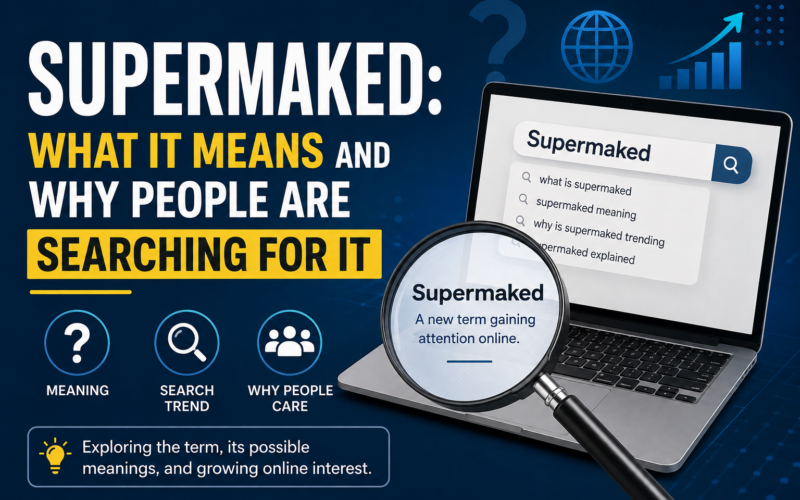
There are moments online when a single unfamiliar word catches your attention and refuses to disappear. Supermaked is one of those terms. At first glance, it looks like a typo, a brand name, or perhaps a newly coined expression. Yet that uncertainty is exactly what makes it interesting. In a digital environment where usernames, search queries, domains, product names, and invented words can develop their own identities, terms like supermaked deserve a closer look.
For entrepreneurs, technology readers, creators, and founders, unfamiliar digital terminology is rarely meaningless. A strange word can point toward a website, an online identity, a community, a project, or simply a search trend that has started attracting curiosity. Understanding that context matters because the internet increasingly creates meaning through usage rather than traditional dictionaries.
What Does Supermaked Mean?
The first challenge with supermaked is straightforward: it does not have one universally established dictionary definition. Its interpretation depends heavily on where the term appears and how people use it.
The structure of the word is also intriguing. The prefix “super” commonly suggests something enhanced, exceptional, or above an ordinary level. The second portion, “maked,” resembles a variation of “made” or “marked,” although neither interpretation should automatically be treated as the official meaning.
This uncertainty is important. When encountering an unfamiliar term online, it is tempting to assign a definition immediately. A better approach is to examine its context. A word appearing in a username may function primarily as an identity. On a website, it could represent a brand. Within a social platform, it might be a handle or community reference. In a technology discussion, meanwhile, it could describe a project or digital product. Therefore, the meaning of supermaked should be considered contextual rather than fixed.
Why Unfamiliar Terms Matter in the Digital Economy
The modern internet has changed the way language evolves. Traditionally, words gained recognition through books, journalism, education, and everyday conversation. Today, search engines, social networks, online marketplaces, gaming communities, and software platforms can accelerate that process dramatically. A newly created term can become recognizable without ever appearing in a conventional dictionary.
This has significant implications for businesses. A memorable digital term can become an asset if it is attached to a useful product or consistent identity. Companies spend considerable effort developing names that are distinctive, searchable, and easy to associate with their offerings. Supermaked illustrates this broader phenomenon. Whether the term ultimately becomes associated with a specific project or remains a niche online expression, its existence demonstrates how digital language is increasingly shaped by networked communities.
Supermaked and the Evolution of Online Identity
Online identity is no longer limited to a person’s real name. A founder may operate under a professional username. A developer may build an open-source project around a distinctive label. A creator may establish a recognizable identity through a short phrase. Even an apparently random combination of letters can become meaningful after repeated exposure.
This creates an important principle: digital identity is often built through consistency rather than vocabulary. If a name appears repeatedly across a website, social account, product page, or professional profile, users begin associating the term with an entity or idea. Over time, that association can become stronger than the literal meaning of the word.
The same principle can apply to supermaked. Its value, if it develops one, will depend less on what the word appears to mean initially and more on how it is used.
How Search Engines Shape Meaning
Search engines play an unusual role in the development of unfamiliar terminology. When users search for an obscure term, search systems attempt to connect it with available pages, entities, websites, and related concepts. As more people search for the same expression, the surrounding digital ecosystem can become easier to identify.
This creates a feedback loop. A user discovers a term. They search for it. They find a few references. Others notice the term and conduct their own searches. New pages may then appear discussing it. Eventually, the expression gains a digital footprint.
For content creators and marketers, this is a reminder that search visibility is not simply about ranking for established words. Distinctive terminology can also create opportunities when supported by genuinely useful content.
Possible Contexts for Supermaked
Because supermaked does not carry a universally accepted definition, examining potential contexts is more useful than presenting a speculative definition as fact.
| Context | How the term may function | What to examine |
|---|---|---|
| Website | Brand, project, or publication name | Ownership, purpose, content |
| Social media | Username or identity | Profile activity and consistency |
| Technology | Product or project label | Features, documentation, developers |
| Marketing | Campaign or coined phrase | Audience and messaging |
| Search | Emerging query or niche term | Search results and related phrases |
| Community | Informal expression | How members use the word |
This contextual approach avoids one of the most common mistakes in online research: turning an assumption into a fact.
The Branding Potential of Invented Words
One reason businesses create unusual names is simple: conventional words are often already crowded. A distinctive invented term can offer several advantages. It may be easier to register as a domain, distinguish in search results, or associate with a particular product. It can also give a company more freedom to define its own meaning. Consider the difference between a generic word and a coined name. A generic term already carries years of cultural associations. An invented expression starts with a relatively blank canvas.
That blank canvas can be powerful. However, unusual branding also carries risks. If a name is difficult to pronounce, spell, remember, or understand, users may struggle to find it again. A successful digital name therefore needs more than uniqueness. It needs usability. Supermaked is memorable partly because it creates a small moment of curiosity. A reader sees it and wonders what it means. From a branding perspective, curiosity can be valuable when the surrounding experience provides a clear answer.
What Entrepreneurs Can Learn From the Term
Entrepreneurs often focus heavily on product development while treating naming as a secondary decision. In reality, a name can influence discoverability, recognition, and the first impression of a business. An unusual term can work particularly well when three conditions are present.
First, the name should be distinctive enough to stand apart. Second, the organization should use it consistently across important digital channels. Third, the audience should eventually connect the name with a clear value proposition. Without the third element, even a highly memorable name can remain confusing. This is why context matters so much. A successful digital identity gradually teaches its audience what the name represents.
Why Context Is More Reliable Than Guesswork
Suppose someone encounters supermaked without any surrounding information. They might interpret it as “super made,” “super marked,” a brand, or a username. Each interpretation is plausible, but none can be confirmed simply by looking at the spelling. This is where responsible digital research becomes important. Instead of asking only, “What does this word mean?” it is often better to ask:
Where did the term appear?
Who is using it?
What kind of content surrounds it?
Is it connected to a company, person, product, or platform?
Does the spelling remain consistent across references?
These questions provide much stronger evidence than linguistic speculation.
For technology professionals, this mindset is particularly useful. Digital ecosystems contain countless identifiers that do not behave like ordinary words. Treating every unfamiliar string as a conventional dictionary term can produce inaccurate conclusions.
Supermaked in the Broader Trend of Digital Naming
The rise of artificial intelligence, software platforms, creator economies, and online communities has accelerated the creation of new terminology. Today, people routinely encounter usernames, startup names, product labels, acronyms, shortened expressions, and deliberately invented words. Some disappear quickly. Others become recognizable brands. This means the boundary between language and identity is becoming increasingly blurred.
A term can be simultaneously a word, a search query, a username, a brand, and a cultural signal. Its significance emerges from the network surrounding it. Supermaked is interesting within this broader trend because its ambiguity encourages investigation. Rather than immediately assigning it a definition, readers are pushed toward understanding its digital context.
The Importance of Digital Footprints
Every established online identity leaves evidence. Web pages, social profiles, mentions, archived content, product references, and user discussions can collectively form a digital footprint. Researchers and businesses can examine these signals to understand whether a term represents an active identity or simply an isolated expression.
For organizations, this also highlights the importance of maintaining consistency. If a company uses different spellings across its website, social accounts, and marketing materials, search engines and users may struggle to connect those references. Consistency strengthens recognition.
For individuals, the same principle applies. A consistent professional identity makes it easier for colleagues, customers, and potential partners to find the right person.
What Supermaked Represents for Modern Tech Readers
The deeper lesson behind supermaked is not necessarily the word itself. It is the changing nature of meaning online. Technology has created an environment where terminology can emerge almost instantly. A developer can name a project today. A creator can introduce a phrase tomorrow. A community can turn an unfamiliar expression into an inside reference within weeks.
Some of these terms become commercially valuable. Others remain obscure. Their outcomes depend on adoption, context, consistency, and usefulness. For technology readers, recognizing this evolution can sharpen digital literacy. Instead of assuming every unfamiliar term has a conventional definition, readers can investigate how it functions within its environment.
How to Research an Unknown Digital Term
A disciplined research process is useful whenever an unfamiliar expression appears. Start with the exact spelling. Even a single character can lead to completely different search results. Next, examine the most relevant references and look for repeated patterns. Pay attention to whether the term refers to an organization, individual, product, service, or informal expression.
Then compare multiple independent references rather than relying on one page. Most importantly, separate confirmed information from interpretation. If a term has no established definition, saying so is more credible than inventing an authoritative-sounding explanation. This approach is especially valuable for publishers. Readers increasingly expect technology journalism to distinguish between evidence and speculation.
The Future of Terms Like Supermaked
The future of supermaked will ultimately depend on adoption. If a company, creator, community, or technology project consistently uses the term, it may develop a recognizable association. If usage remains limited, it may continue to function primarily as a niche digital identifier.
Either outcome is normal. The internet produces enormous numbers of new names every day. Only a fraction survive long enough to become widely understood. Those that do generally acquire meaning through repeated use. That process cannot be forced simply by publishing a definition. Meaning becomes durable when real people repeatedly connect a term with a recognizable idea, experience, or identity.
Conclusion: Meaning Is Built Through Context
Supermaked is a useful example of how difficult it can be to interpret modern digital terminology outside its original context. Rather than forcing a single definition onto the word, it is more accurate to examine where it appears, who uses it, and what identity or purpose surrounds it. For entrepreneurs and technology professionals, the broader lesson is even more valuable. In today’s digital economy, names are not merely labels. They can become searchable assets, brand foundations, community identifiers, and long-term digital properties.
An unfamiliar word may look insignificant at first. Yet with consistent use, the right context, and a meaningful purpose behind it, that same word can become recognizable. That is ultimately how many modern digital identities are built: not because a dictionary tells us what they mean, but because people repeatedly give them meaning.