
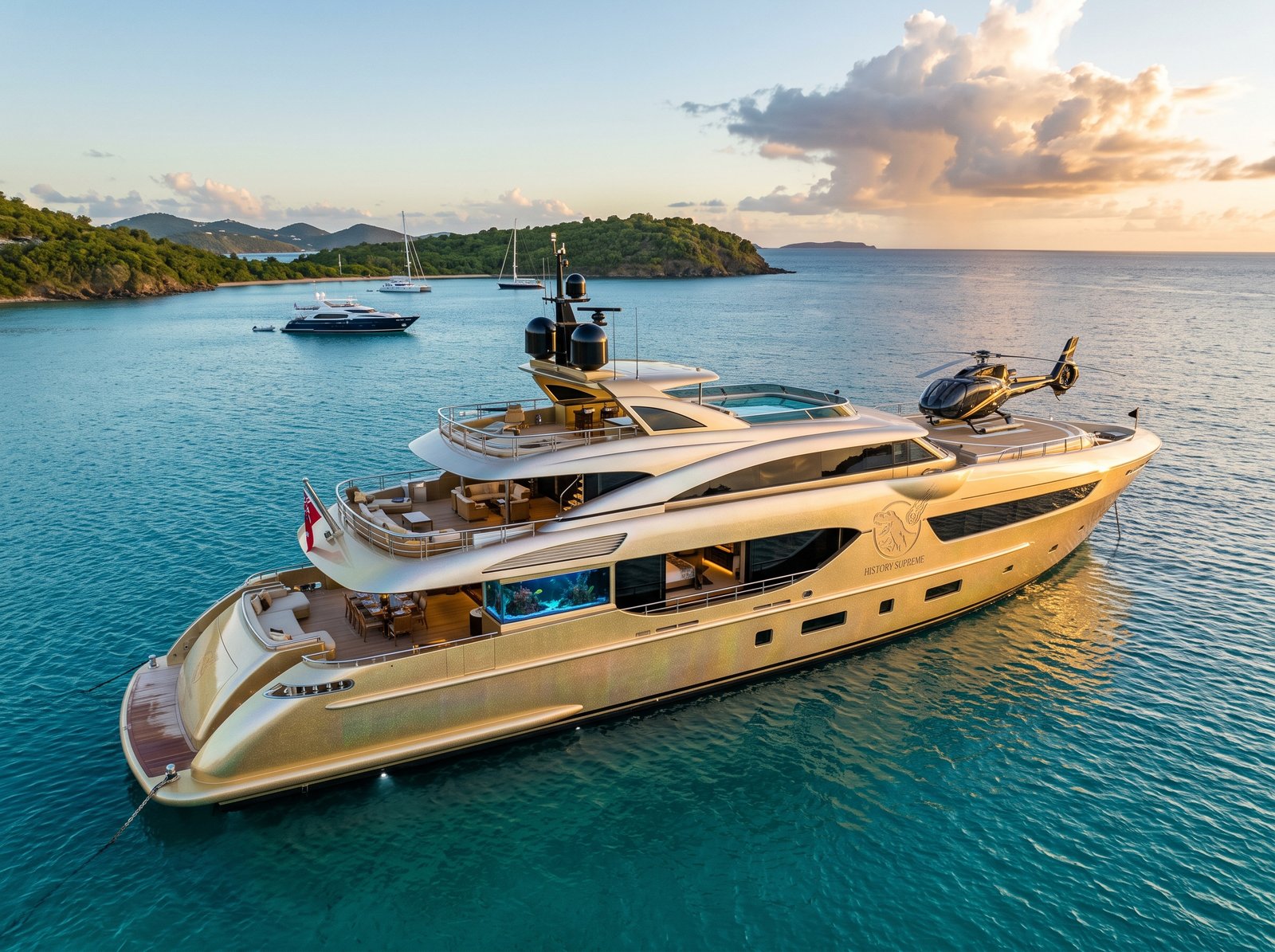
If you search “world’s most expensive yacht” today, you’ll almost certainly land on a story about History Supreme — a $4.8 billion vessel supposedly wrapped in solid gold and platinum. There’s just one problem: after more than a decade of investigation by yachting journalists, insurers, and maritime experts, the overwhelming consensus is that History Supreme almost certainly does not exist.
Key Takeaways
- History Supreme is widely reported as a $4.8 billion superyacht coated in 100,000 kilograms of gold and platinum, but no shipyard, maritime registry, or independent photograph has ever confirmed it was built
- The story originated in July 2011 when UK-based luxury designer Stuart Hughes claimed to have completed the vessel for an anonymous Malaysian businessman
- Investigations by multiple outlets, including a direct denial from the shipyard whose photos were allegedly used, point strongly toward the yacht being a fabricated PR story
How the Story Began
The History Supreme legend traces back to a single source: British designer Stuart Hughes, known for gold-plating consumer electronics like iPhones and iPads, announced in mid-2011 that he had spent three years overseeing the construction of a superyacht coated in gold and platinum for an anonymous Malaysian businessman. According to Hughes, the vessel measured roughly 100 feet in length, used approximately 100,000 kilograms of precious metal across its hull, decks, railings, dining area, and even its anchor, and cost a staggering $4.8 billion.
The claims didn’t stop at metal. Hughes also described a master suite featuring a wall made from meteorite rock and a feature incorporating genuine Tyrannosaurus Rex bone, along with a $35 million liquor bottle called the D’Amalfi Limoncello Supreme, set with an 18.5-carat diamond.
Also Read: Eclipse Yacht: Inside the World’s Most Secretive 162-Metre Superyacht
Why Yachting Experts Don’t Believe It’s Real
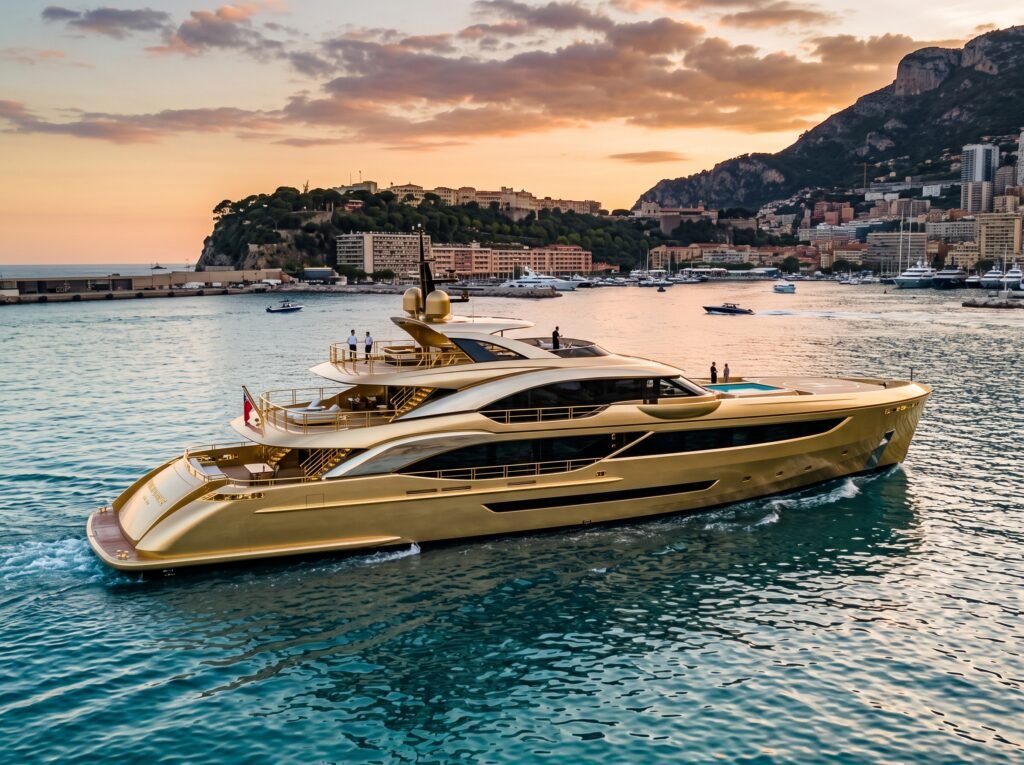
The case against History Supreme’s existence has built steadily since 2011, and it rests on several independent lines of evidence rather than a single source.
The photos were traced to a different yacht entirely. When Motor Boat & Yachting investigated the story, Italian shipyard Baia confirmed that the handful of images circulating online had been taken from photos of its own Baia One Hundred model without permission. Baia’s sales manager at the time bluntly dismissed the claims, questioning who would believe a boat could carry 100 tons of gold.
The physics don’t work. A vessel plated in 100,000 kilograms of gold and platinum would face severe buoyancy, stability, and performance problems a concern echoed by insurance specialists who note that a boat of that reported weight would struggle to stay afloat, let alone cruise. Multiple maritime engineers cited across independent investigations have made the same point: gold and platinum cladding at that scale isn’t just impractical, it’s close to physically unworkable for a vessel intended to actually sail.
No registry, sighting, or shipyard has ever confirmed it. Unlike genuine super— which are typically registered, insured, tracked via AIS, and spotted repeatedly at marinas and yacht shows History Supreme has never been documented arriving at, or departing from, any port in the fourteen-plus years since the story broke.
The math on the price doesn’t hold up either. At current metal prices, even a substantial platinum-and-gold cladding wouldn’t approach $4.8 billion; that figure only makes sense using 2011-era gold prices, a detail that further undermines the story’s credibility since the number has never been revised despite over a decade passing.
The Robert Kuok Connection
Because Hughes described his client only as “an anonymous Malaysian businessman,” online speculation quickly attached the story to Robert Kuok, widely regarded as Malaysia’s wealthiest individual, with a net worth of approximately $13.2 billion as of 2026, built through the Kuok Group’s interests spanning commodities, hotels, and real estate across Southeast Asia. However, neither Kuok nor any representative of his companies has ever confirmed a connection to the yacht, and no financial filings, customs paperwork, or transfer records have ever surfaced to support the claim. Industry analysts who’ve examined the story note that Kuok’s well-documented business style, centered on pragmatic, large-scale commercial ventures, doesn’t align with the extreme, publicity-driven excess the History Supreme story implies.
Why This Matters for Yacht Buyers and Enthusiasts
Beyond the entertainment value of a good hoax, the History Supreme story is a useful case study in how easily unverified claims spread across the yachting world — and it highlights something worth knowing for anyone researching real superyacht purchases, valuations, or the market at large.
When evaluating claims about record-breaking yachts, several verification points separate real vessels from myths: confirmed shipyard involvement, classification society registration (such as Lloyd’s Register or DNV), consistent AIS tracking data, and multiple independent sightings at marinas or yacht shows over time. Genuine record-holders like Azzam, a 180-metre vessel built by German shipyard Lürssen and reportedly costing around $600 million, and Dilbar, an 156-metre Lürssen-built yacht delivered in 2016 with an original price tag approaching $800 million, satisfy all of these markers. History Supreme satisfies none of them.
This matters practically, too: publications and buyers who repeat unverified valuation claims risk badly distorting the public’s understanding of what a superyacht actually costs. A genuinely enormous, fully custom 180-metre-plus yacht like Azzam tops out at a small fraction of History Supreme’s claimed price which itself is a signal that something doesn’t add up.
What a Real Ultra-Luxury Yacht Actually Costs
For comparison, real verified superyachts at the very top of the market vessels confirmed through shipyards, classification societies, and public sightings generally fall in the $500 million to $800 million range even at their most extreme, with ongoing annual maintenance typically running 10–15% of a yacht’s value each year to cover crew salaries, hull upkeep, insurance, dockage, and technology upgrades. That means even a genuinely enormous, fully custom yacht carries running costs in the tens of millions annually — expensive by any standard, but nowhere near the fictional $480 million-a-year maintenance figure that would theoretically apply to a $4.8 billion vessel.
The Bigger Picture: Hoaxes in the Luxury World
History Supreme isn’t unique in this respect. The luxury goods and superyacht space has produced other unverified or exaggerated claims over the years, often originating from designers or PR sources seeking publicity rather than shipyards with a track record of delivering real vessels. The lesson for readers is straightforward: claims about extreme wealth, especially unverifiable ones tied to anonymous buyers, deserve the same scrutiny as any other unconfirmed news story, regardless of how many outlets have repeated them.
FAQ
Does the History Supreme yacht actually exist?
No credible evidence supports its existence. No shipyard, maritime registry, or independent photograph has ever confirmed the vessel was built, and the only images associated with it were traced to a different, unrelated yacht model.
Who owns the History Supreme yacht?
Nobody has been verifiably confirmed as the owner. Malaysian businessman Robert Kuok is frequently named in online speculation, but he has never acknowledged any connection to the yacht, and no supporting documentation has ever surfaced.
How much gold was supposedly used on History Supreme?
Designer Stuart Hughes claimed approximately 100,000 kilograms of gold and platinum were used throughout the vessel’s hull, deck, railings, and interior, though this figure has never been independently verified.
What is the real most expensive yacht in the world?
Among verified, documented superyachts, vessels like Eclipse, Azzam, and Dilbar rank among the most expensive, with reported costs generally between $600 million and $800 million — far below History Supreme’s claimed $4.8 billion.
Why do so many websites still describe History Supreme as real?
Many articles continue to repeat the original 2011 claims without independent verification, allowing the story to persist online despite multiple investigations concluding it is almost certainly a hoax.