



There are moments when the world seems to move faster than our ability to make sense of it. A founder watches a promising company suddenly lose momentum. A technology team discovers that yesterday’s breakthrough has become today’s expected feature. A creator builds an audience only to find that the platform, algorithm, or culture around them has changed overnight. Somewhere between uncertainty and adaptation, a useful idea begins to emerge: stormuring.
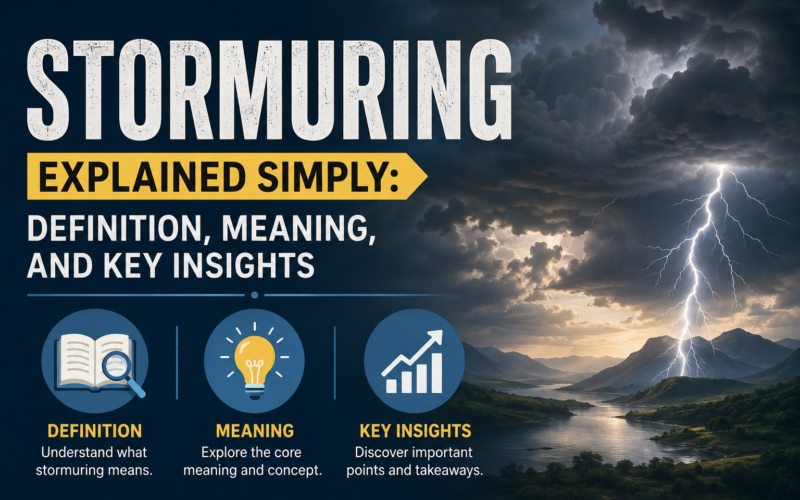
The term is unusual, and that is precisely what makes it interesting. Stormuring can be understood as a conceptual way of describing how people, organizations, and systems move through periods of intense disruption while attempting to create structure, meaning, and forward momentum. It evokes the image of navigating a storm while simultaneously shaping the route ahead.
In a technology-driven world, that idea has increasing relevance. Disruption is no longer an occasional event reserved for moments of economic crisis or technological revolution. It has become part of everyday operating reality.
What Does Stormuring Really Mean?
Stormuring is best approached as a developing concept rather than a rigid technical term with one universally accepted definition. At its heart is the relationship between turbulence and intentional movement.
The “storm” represents uncertainty, pressure, competing forces, rapid change, and conditions that cannot be completely controlled. The “-uring” element suggests an ongoing process rather than a finished state. Together, the idea points toward continuous navigation: responding to disruption while actively constructing a better direction.
This distinction matters.
Traditional approaches to change often assume that disruption has a beginning, middle, and end. A company experiences a crisis, implements a solution, stabilizes operations, and returns to normal. Digital environments rarely work that way. The environment itself keeps changing.
Consequently, resilience cannot simply mean surviving a difficult period. It increasingly means developing the ability to learn, adjust, experiment, and make decisions while conditions remain unstable.
Stormuring captures that mindset.
Why the Concept Matters in the Technology Era
Technology has dramatically increased the speed at which systems evolve. Cloud computing can transform infrastructure decisions within months. Artificial intelligence is reshaping knowledge work at extraordinary speed. Social platforms can change consumer behavior almost instantly. Global digital networks can turn a local development into an international conversation within hours.
For entrepreneurs and technology leaders, this creates a paradox.
More information should theoretically make decision-making easier. Yet an abundance of information can create its own form of uncertainty. Leaders must distinguish meaningful signals from noise, permanent shifts from temporary trends, and strategic opportunities from distractions.
That is where the stormuring mindset becomes useful.
Instead of asking, “How can we eliminate uncertainty?” a leader asks, “How can we become better at operating within uncertainty?”
The second question is more realistic.
No organization can predict every market movement, customer reaction, competitor strategy, or technological breakthrough. However, an organization can build systems that allow it to respond intelligently when those variables change.
From Resilience to Active Adaptation
Resilience has traditionally been associated with endurance. . A resilient company continues operating after a crisis. A resilient system withstands pressure.
Stormuring adds another dimension: creation.
The objective is not simply to return to the previous state. It is to use pressure as information.
Consider a technology startup facing a sudden shift in customer expectations. A defensive organization may attempt to preserve its existing product at all costs. A more adaptive organization might investigate why expectations changed, identify what remains valuable, and redesign its offering around the new reality.
The difference is subtle but significant.
One organization treats the storm as an obstacle. The other treats it as a source of intelligence.
That approach can produce stronger businesses because it encourages continuous learning rather than occasional transformation.
Stormuring in Business and Entrepreneurship
Entrepreneurs operate in environments where uncertainty is almost unavoidable. Funding conditions change. Customers reconsider priorities. Competitors introduce unexpected products. Regulations evolve. Technologies become obsolete.
A successful founder therefore needs more than a compelling idea.
They need adaptive judgment.
Stormuring offers a useful framework for understanding that capability. It suggests that entrepreneurial strength comes from balancing conviction with flexibility. A founder must believe strongly enough in a vision to pursue it, while remaining flexible enough to change the path toward that vision.
This balance is difficult.
Too much rigidity creates fragility. Too much flexibility creates confusion.
The strongest organizations often establish a stable purpose while allowing their methods to evolve.
| Traditional Response to Disruption | Stormuring-Oriented Response |
|---|---|
| Protect the existing model | Reconsider what still creates value |
| Wait for certainty | Make informed decisions with incomplete information |
| Treat failure as an endpoint | Treat failure as usable feedback |
| Focus on restoring stability | Build stronger adaptability |
| Follow established assumptions | Test assumptions continuously |
This is particularly important for early-stage companies. Startups rarely have the resources to respond to every change. They must determine which changes deserve attention and which can safely be ignored.
Stormuring, therefore, is not about reacting to everything.
It is about learning how to react to the right things.
The Human Side of Constant Disruption
Technology discussions often focus on systems, products, data, and automation. Yet every technological system ultimately affects people. Constant change can produce cognitive fatigue. Employees may feel that priorities are continuously shifting. Leaders can experience decision overload. Customers can become frustrated when familiar experiences disappear without explanation.
An organization that embraces adaptation without considering human capacity can become highly agile and deeply exhausted at the same time. That is why the human dimension matters. A mature approach to stormuring recognizes that people need context, trust, and psychological space to adapt effectively. Communication becomes just as important as technology. Leaders need to explain not only what is changing, but why it is changing and what remains stable. This creates a crucial distinction between healthy adaptability and organizational chaos.
Change without direction feels chaotic.
Technology as Both Storm and Compass
Technology itself can be part of the disruption and part of the solution.
Artificial intelligence is a powerful example. It creates uncertainty around jobs, workflows, intellectual property, customer service, education, and business models. At the same time, it gives organizations new tools for analyzing information, automating repetitive work, modeling scenarios, and discovering opportunities.
The same technology can therefore function as both storm and compass. That dual role will become increasingly common.
Automation can eliminate inefficient processes while creating new responsibilities. Data can reveal hidden customer behavior while introducing privacy concerns. Digital platforms can expand reach while making businesses dependent on systems they do not control. Technology leaders must therefore think beyond adoption. The important question is not simply whether an organization should use a new technology. The more valuable question is how that technology changes the organization’s ability to respond to future uncertainty.
Building a Stormuring Culture
A culture capable of navigating disruption does not emerge from motivational slogans. It develops through everyday practices. Teams need permission to experiment responsibly. Managers need mechanisms for learning from unsuccessful projects. Leaders must be willing to revise assumptions when evidence changes. Communication needs to move quickly without becoming careless.
Perhaps most importantly, organizations need to distinguish between mistakes and learning. A failed experiment is not necessarily a failure of leadership. Sometimes it is evidence that prevents a much larger mistake later. This does not mean celebrating every failure. It means extracting value from it.
Organizations that continuously document lessons, test assumptions, and review decisions can gradually develop institutional intelligence. Over time, the company becomes better not because it predicts every storm, but because it becomes better at navigating unfamiliar conditions.
What Stormuring Could Mean for the Future
The concept becomes particularly interesting when viewed beyond business. Cities are facing climate pressures, infrastructure challenges, population changes, and increasingly connected systems. Education is being reshaped by artificial intelligence and remote learning. Healthcare, finance, manufacturing, and media are experiencing similar waves of transformation.
In each case, the old model of stability is becoming less reliable. Future organizations may therefore compete not only on efficiency or innovation, but on adaptive capacity. The winners may be those that can identify change early, interpret it intelligently, and reorganize without losing their identity.
That requires a different kind of leadership. Instead of positioning leaders as people who always have the answer, the future may favor leaders who know how to ask better questions when the answer is unclear.
A More Useful Definition of Progress
There is another reason stormuring deserves attention: it challenges the conventional idea of progress. Progress is often portrayed as a straight line. Companies grow. Products improve. Technology advances. Individuals accumulate knowledge.
Real life is rarely so orderly. Progress frequently happens through disruption. A failed product reveals a better opportunity. A market collapse exposes weaknesses that growth had hidden. A technological shift forces an organization to reconsider assumptions it had treated as permanent.
From this perspective, uncertainty is not necessarily the enemy of progress. Sometimes it is the environment in which progress becomes possible. Stormuring gives language to that experience. It describes the ongoing work of moving forward while the conditions around you remain unsettled.
The Leadership Lesson
For executives, founders, and technology professionals, the deepest lesson is not to become comfortable with chaos. Chaos itself is not inherently valuable. The lesson is to develop competence within uncertainty.
That means creating organizations that can absorb new information without losing direction. It means building teams that can challenge assumptions without creating paralysis. It means investing in technology while recognizing its limitations. And it means understanding that strategy is not always a fixed map.
Sometimes strategy is a navigation system. The destination may remain clear, but the route must change according to the landscape.
Conclusion
Stormuring offers an intriguing lens for understanding modern life because it does not promise a world without disruption. Instead, it recognizes disruption as a permanent feature of an increasingly connected and technologically accelerated environment.
For entrepreneurs and technology leaders, that perspective can be valuable. The future will rarely arrive in a neat sequence of predictable stages. New technologies will collide with old assumptions. Markets will shift. Customers will redefine expectations. Unexpected problems will create unexpected opportunities.
The organizations that endure will not necessarily be those that experience the fewest storms. They may be the ones that learn how to navigate them without losing sight of what matters. Ultimately, stormuring is less about weathering uncertainty than transforming our relationship with it. The storm may be unavoidable. Our response to it is not.