
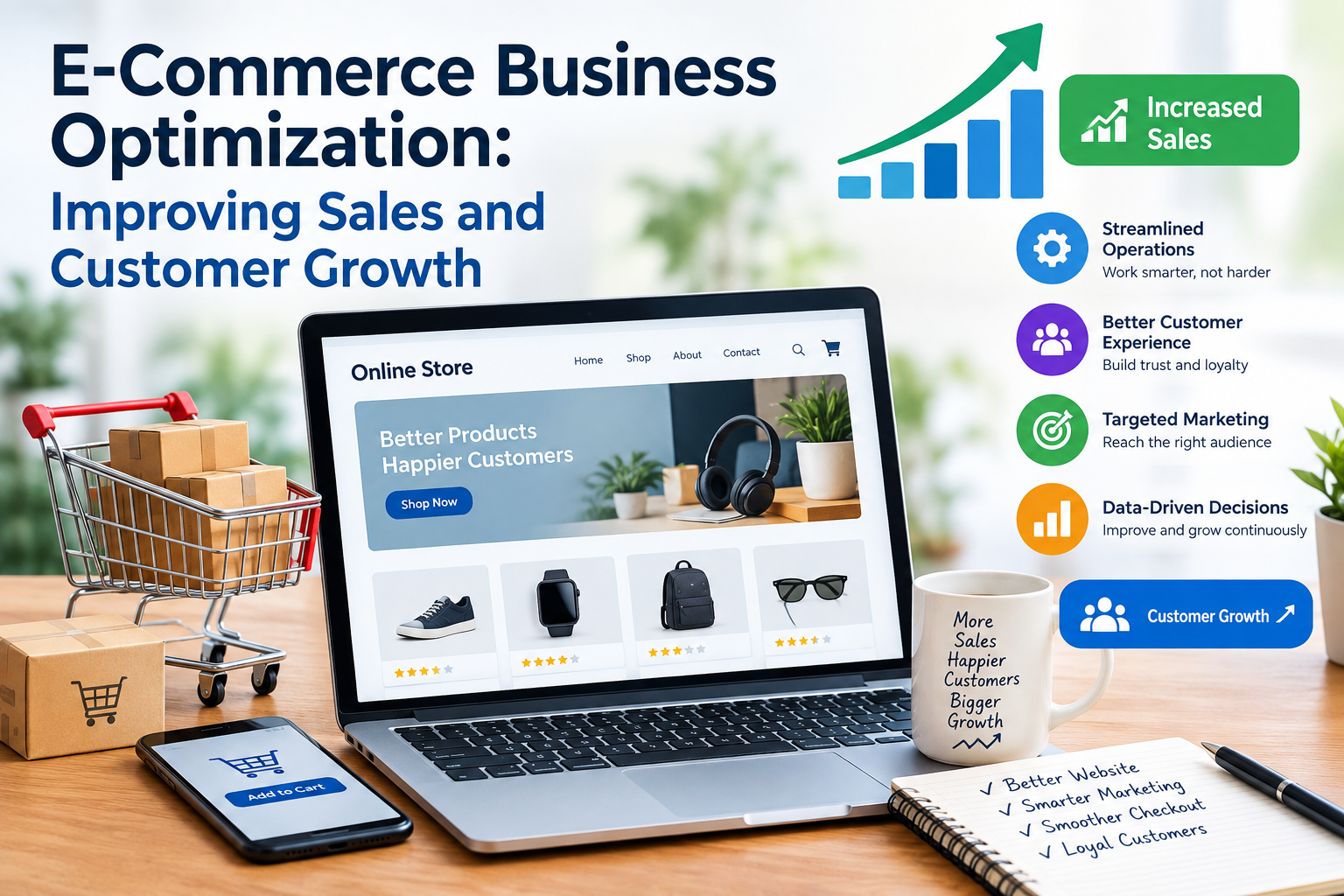
E-commerce has made it easier for businesses to reach customers, but simply having an online store is no longer enough to generate consistent sales. Customers expect fast websites, clear product information, convenient checkout options, reliable delivery, and a shopping experience that feels simple from beginning to end. For this reason, e-commerce business optimization has become an important part of building sustainable online revenue.
Optimization is not limited to changing a website’s design. It involves improving the complete customer journey, from the first search or advertisement to product discovery, checkout, delivery, and repeat purchasing. A well-optimized store can make better use of existing traffic, reduce unnecessary friction, and create stronger reasons for customers to complete their purchases.
What Is E-Commerce Business Optimization?
E-commerce business optimization is the process of improving an online store, its customer journey, marketing activities, and business operations to increase sales and create a better customer experience. It combines elements such as website usability, search visibility, product presentation, conversion rate optimization, customer retention, and performance analysis. Businesses can also explore broader Digital Commerce to understand the strategies shaping modern online commerce.
The goal is not simply to attract more visitors. A store can receive thousands of visits and still struggle if shoppers cannot find the right products, understand the offer, trust the business, or complete checkout easily. Conversion rate optimization therefore focuses on identifying where potential customers leave and improving those stages of the buying journey. Shopify similarly describes ecommerce conversion optimization as an ongoing process of testing and refining areas such as product pages and checkout.
This makes optimization particularly valuable for businesses that are already generating traffic but are not receiving enough orders. Improving the experience for existing visitors can sometimes create more value than continuously increasing advertising expenditure.
Start With a Clear E-Commerce Value Proposition
Customers should understand what a store sells and why they should consider buying from it within a few moments of arriving. A strong value proposition communicates the product category, primary benefit, and reason to choose the business without forcing visitors to search through several pages.
For example, an online furniture store could emphasize durable materials, flexible delivery, or carefully designed products rather than simply displaying a generic statement such as “Welcome to Our Store.” The message should match what the target customer actually values.
Product pages should follow the same principle. Descriptions need to explain what the product does, who it is suitable for, important specifications, available options, and relevant purchasing information. High-quality images can support the description by helping shoppers understand the product before making a decision.
When product information is incomplete, customers may leave the website to search for answers elsewhere. Clear information reduces uncertainty and gives shoppers more confidence when comparing products.
Improve Website Navigation and Product Discovery
Navigation plays an important role in e-commerce because customers often arrive with different levels of purchase intent. Some already know exactly what they want, while others are exploring categories and comparing options.
A logical category structure makes it easier for both groups to move through the store. Products should be organized according to how customers naturally search for them rather than how the business internally manages its inventory.
Search functionality is also important for larger stores. Customers should be able to search by product name, category, brand, or relevant attributes when appropriate. Filters can further improve discovery by allowing shoppers to narrow products according to price, size, color, specifications, availability, or other meaningful characteristics.
The objective is to reduce unnecessary clicks between the customer’s initial interest and the product they want to purchase.
Optimize Product Pages for Conversions
The product page is often one of the most important parts of an online store because it is where visitors evaluate whether an item deserves their money. A strong product page should answer the questions that normally arise before purchasing.
Product titles should be specific and understandable. Descriptions should focus on useful information rather than filling the page with generic marketing language. Images should show the product clearly from useful angles, while variations such as size, color, or configuration should be easy to select.
Price, availability, shipping information, returns, and purchasing options should also be visible without making the customer search through unrelated sections. Reviews and customer-generated feedback can provide additional reassurance where they are genuine and relevant.
This is especially important because online shoppers cannot physically examine a product before buying it. Clear information and trustworthy presentation help compensate for that limitation.
Make the Checkout Experience Simpler
A customer who has reached checkout has already demonstrated strong purchase intent. Losing that customer because the checkout process is confusing or unnecessarily long can be costly.
Businesses should examine every step required to complete an order. Unnecessary form fields, forced account creation, unclear shipping costs, limited payment methods, and unexpected fees can create friction at the final stage of the buying journey.
Recent e-commerce research highlights additional costs, slow delivery, forced account creation, payment-security concerns, and complicated checkout processes among factors associated with purchase abandonment.
A better checkout should make important information easy to understand before payment. Customers should know the final price, delivery expectations, available payment methods, and relevant return conditions without encountering unexpected surprises.
Guest checkout can also be useful when customers do not want to create an account before completing their first purchase. The objective is straightforward: remove unnecessary barriers while maintaining security and accuracy.
Treat Mobile Optimization as a Business Priority
Mobile optimization should not be treated as a secondary design task. Many customers discover products, compare prices, and complete purchases using smartphones. A store that works well on desktop but performs poorly on mobile can lose a substantial portion of its potential revenue.
Mobile pages should load efficiently, product images should display properly, buttons should be easy to tap, and menus should remain simple. Text should be readable without excessive zooming, while checkout forms should require as little unnecessary typing as possible.
Website speed is another important consideration. Large images, excessive scripts, poorly configured plugins, and unnecessary third-party resources can slow down a store. Improving technical performance can therefore contribute to both user experience and conversion optimization.
E-commerce UX research emphasizes navigation, product-page usability, checkout, mobile experiences, and page performance as important components of the overall shopping experience.
Use SEO to Build Sustainable E-Commerce Traffic
Search engine optimization remains valuable because it can bring customers who are actively looking for products, solutions, comparisons, and information. However, e-commerce SEO should focus on genuine search intent rather than simply adding keywords to product pages.
Category pages can target broader commercial searches, while individual product pages can address specific product-related queries. Informational content can support the journey by answering questions customers have before purchasing.
For example, a business selling home office equipment might create content around choosing an ergonomic desk, comparing different desk materials, or understanding the features that matter when selecting an office chair. These pages can introduce potential customers to the brand before they are ready to purchase.
Internal linking should also connect related content with relevant categories and products. This creates a more useful information structure for visitors while helping search engines understand the relationships between different pages.
For businesses building a broader online presence, resources covering e-commerce business strategies can also provide useful context around the wider e-commerce landscape.
Build Trust Before Asking for the Sale
Trust is one of the most important factors in online commerce because customers must make purchasing decisions without physically visiting a store. A professional website alone is not enough; shoppers need evidence that the business is legitimate and reliable.
Clear contact information, transparent policies, secure payment processes, understandable shipping terms, and genuine customer reviews can all contribute to credibility. Businesses should avoid making exaggerated claims that cannot be supported.
Customer reviews can be particularly useful when they provide specific experiences rather than vague statements. Product feedback about quality, sizing, usability, delivery, or durability can help future customers make better decisions.
Trust should also continue after checkout. Accurate order communication, reliable delivery updates, and responsive customer support can turn a first-time buyer into a repeat customer.
Improve Customer Retention
Generating a first purchase is important, but long-term e-commerce growth often depends on what happens afterward. Businesses that continuously acquire new customers without retaining existing ones may need to spend heavily on marketing just to maintain revenue.
Retention begins with a good post-purchase experience. Customers should receive useful order information and have an easy way to get assistance if something goes wrong. Follow-up communication can introduce complementary products, relevant recommendations, or useful information without overwhelming customers.
Personalization can also improve the experience when it is based on meaningful customer behavior. A customer who repeatedly purchases a particular category may respond better to relevant recommendations than to completely unrelated promotions.
The purpose is not to send more messages. It is to make communication more useful.
Use Data to Find Where Sales Are Being Lost
Effective optimization should be based on evidence rather than assumptions. Analytics can show where visitors enter the store, which pages receive attention, where customers leave, and which products generate the strongest commercial results.
Conversion rate is one useful measure, but it should not be viewed in isolation. Average order value, add-to-cart behavior, checkout completion, returning customer activity, and revenue by traffic source can provide additional insight.
For example, if a store receives substantial product-page traffic but very few visitors add products to their carts, the problem may involve pricing, product presentation, unclear information, or weak trust signals. If many customers add products but abandon checkout, the issue may exist later in the purchasing process.
Shopify notes that conversion rates vary according to factors such as traffic source, device type, product category, purchase type, and checkout experience, which is why businesses should examine their own funnel rather than relying on one universal benchmark.
Connect Marketing With Store Performance
E-commerce marketing works best when advertising, content, SEO, social media, and the website support the same commercial objectives. Sending more traffic to an underperforming product page does not necessarily solve the underlying problem.
Businesses should consider the relationship between traffic quality and conversion behavior. Someone arriving through an informational search may need more education before purchasing, while someone searching for a specific product may already have strong buying intent.
Landing pages should therefore match the expectations created by the marketing message. If an advertisement promotes a particular product or offer, the visitor should arrive at a page that clearly reflects that message instead of being redirected to a generic homepage.
This consistency improves the customer journey and makes marketing expenditure easier to evaluate.
Test Improvements Instead of Guessing
E-commerce optimization is rarely a one-time project. Customer behavior changes, competitors introduce new offers, devices evolve, and product ranges change. What works today may not produce the same results several months later.
Businesses can test improvements to headlines, product images, calls to action, product descriptions, navigation, offers, and checkout experiences. The important principle is to change meaningful elements systematically and measure what happens afterward.
Small improvements can become significant when they affect a large number of visitors. For example, making product information easier to understand or reducing unnecessary checkout steps can improve the experience for every customer who reaches that stage.
Testing also helps prevent businesses from making major website changes based solely on personal preferences.
Create a Better Balance Between Sales and Customer Experience
Aggressive sales tactics can sometimes generate short-term results, but sustainable e-commerce growth requires a balance between commercial goals and customer expectations. Too many pop-ups, excessive discounts, intrusive messages, or unclear promotional conditions can reduce trust.
A stronger approach is to make the buying decision easier. Provide useful information, present products clearly, explain costs honestly, and make checkout straightforward.
This approach also supports brand building. When customers consistently receive a reliable experience, the business becomes easier to remember and more likely to receive repeat purchases or recommendations.
A useful e-commerce strategy therefore considers both immediate conversion and the long-term relationship between the business and its customers.
The Role of Continuous E-Commerce Optimization
E-commerce business optimization should be treated as an ongoing process rather than a single website redesign. The strongest stores continually examine how customers discover products, how they interact with pages, where they encounter friction, and what encourages them to return.
Businesses can begin by improving the fundamentals: clear product information, simple navigation, fast mobile performance, transparent pricing, trustworthy policies, and an efficient checkout. Once these foundations are working well, deeper testing and personalization can provide further improvements.
The broader goal is to make every stage of the customer journey more useful. Better discovery brings relevant visitors to the store, better product pages help them make informed decisions, and a smoother checkout makes completing the purchase easier. Afterward, strong service and relevant communication can encourage customers to return.
For businesses looking to explore broader business growth and digital commerce topics, ongoing research and practical business insights can help support a wider optimization strategy.
Conclusion
E-commerce success depends on much more than attracting visitors. A business needs an online store that communicates its value clearly, helps customers discover products easily, builds trust, works smoothly on mobile devices, and removes unnecessary friction from checkout.
E-commerce business optimization brings these areas together. By combining SEO, user experience, conversion optimization, analytics, customer retention, and continuous testing, businesses can improve the value generated from their existing traffic while creating a stronger foundation for long-term growth.
The most effective strategy is not necessarily to make an online store more complicated. It is to make the customer journey clearer, faster, more trustworthy, and more useful at every stage. When those fundamentals are consistently improved, increased sales and stronger customer relationships become sustainable outcomes rather than short-term targets.